 Curated by AS
Autopilot Pulse · #04 · 2026-08-31
The AI gateway wars
TL;DR
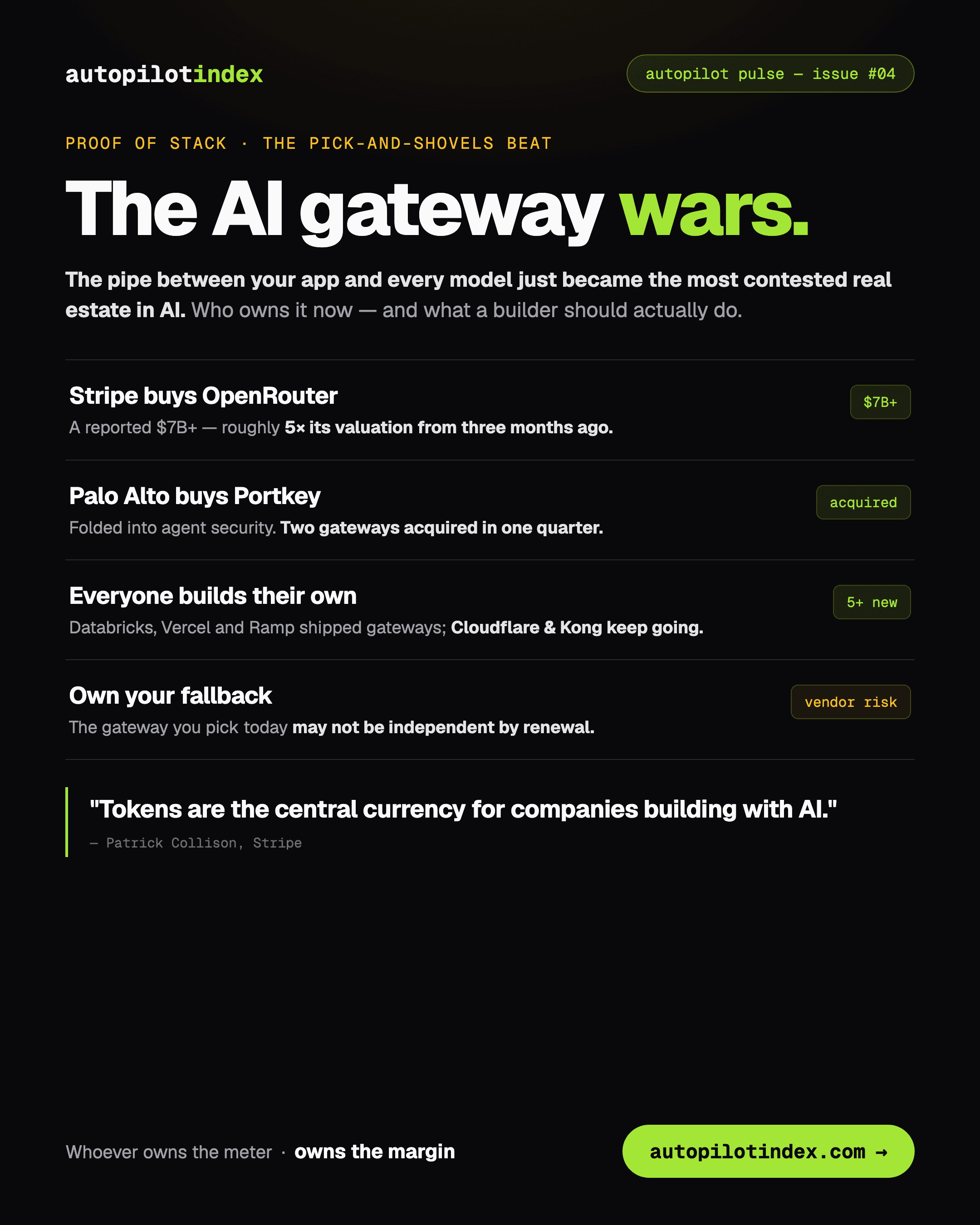
- →The gateway layer — the pipe between your app and every model — just became the most contested real estate in AI. In ~3 months two of the biggest got acquired and everyone else shipped their own.
- →Stripe is acquiring OpenRouter for a reported $7B+ (sources range $7–10B) — roughly 5× the $1.3B valuation it set three months earlier. Signed; closing expected in weeks.
- →Palo Alto Networks bought Portkey (closed May 2026), folding it into agent-security — a second gateway acquisition in one quarter.
- →The platforms are hoarding the layer: Databricks (reportedly bid, lost, shipped its own Unity AI Gateway), Vercel, Ramp, plus incumbents Cloudflare and Kong ($2B valuation).
- →The builder lesson: don't single-thread your gateway, own your fallback, and treat cost-routing as a first-class lever — the difference between a $1.2M and a $100K model bill.
The least glamorous layer of the AI stack is the routing/spend/fallback "gateway" that sits between your app and every model provider. In 2026 it became the most strategic — because whoever owns the meter owns the margin. Here's the consolidation, who owns what now, and what a builder should actually do about it.
You're reading the web copy of Autopilot Pulse #4.
Get the next edition by email. Free.
Confirm your email to join. Unsubscribe anytime.1 — The consolidation, dated
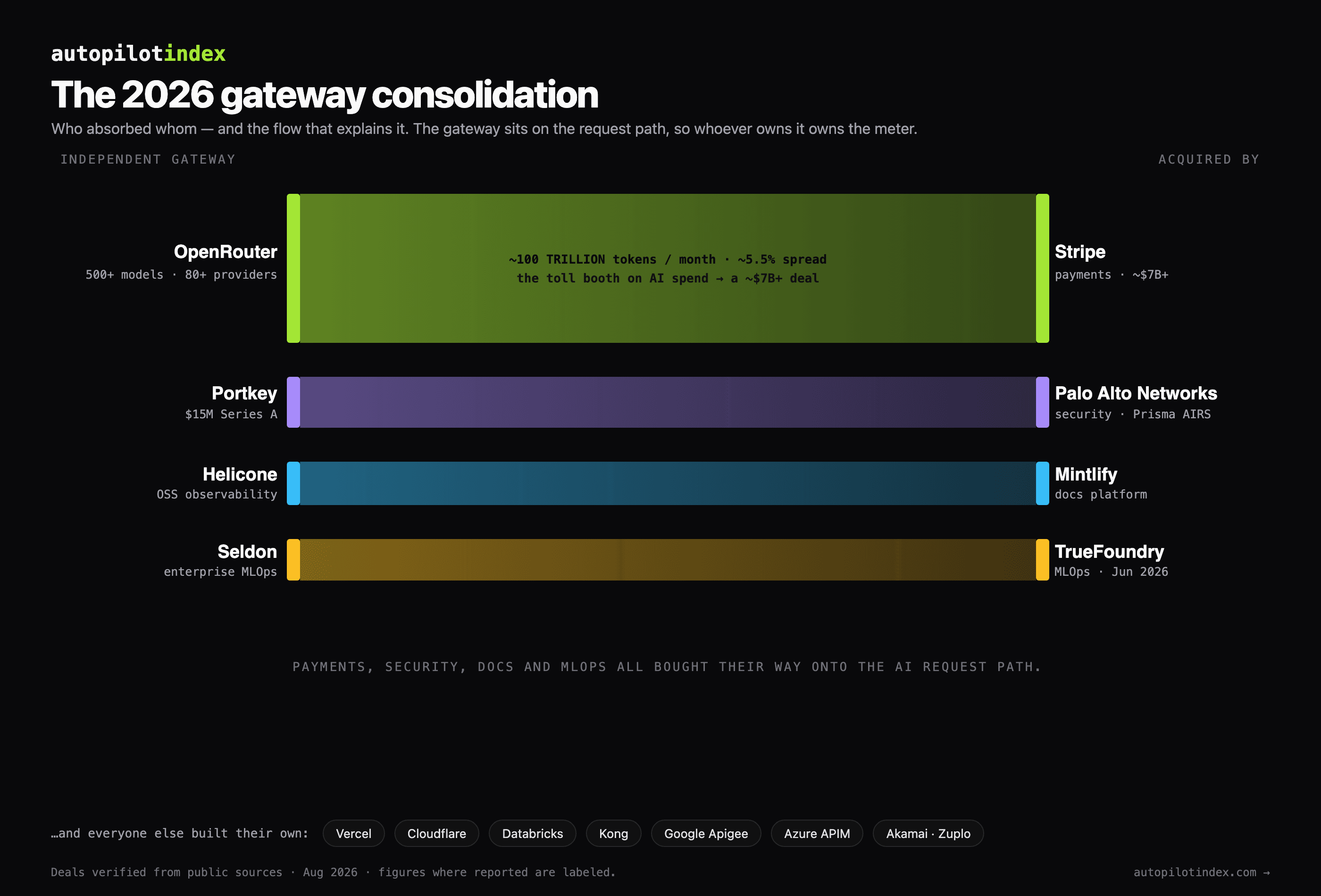
Stripe agreed to buy OpenRouter. Reporting ran from Axios and Bloomberg into Stripe's own newsroom around Aug 19–21; the deal is signed, not yet closed. The price is genuinely unsettled — outlets range $7B to $10B, with $7.5B the best point estimate — a ~5× markup on the $1.3B valuation OpenRouter set just three months earlier. [HIGH the deal is real; MED on the exact figure. Stripe's Patrick Collison put the thesis plainly: *"Tokens are the central currency for companies building with AI."*
Palo Alto Networks bought Portkey (announced April, closed May 2026), folding it into its Prisma AIRS agent-security product [HIGH] — the second gateway swallowed in a single quarter. And Databricks reportedly bid for OpenRouter, lost, and shipped its own Unity AI Gateway instead [MED on the bid; HIGH on the product]. Even a PitchBook piece asked the quiet part out loud: *"Everyone is building AI routers. Are they a dead end?"*
2 — The battlefield, mapped

Independent gateways are where the action (and the exits) are: OpenRouter (500+ models, ~5.5% markup) now Stripe-bound; LiteLLM (open-source, ~$7M ARR, the self-host default); Kong ($175M at $2B) shipping AI Gateway 2.0; Requesty (600+ models, the broadest); Not Diamond ($0.05/M tokens routed); and Sapiom ($50M raised — Accel seed + Dragonfly A), the cost-router we covered whose routing cut one bill ~10×. The churn is just as telling: Helicone was absorbed by Mintlify, Martian pivoted to research, and Unify left for agents — three would-be gateways gone in a quarter.
Platform-owned gateways come at the layer from opposite ends. Vercel AI Gateway (now GA, on Fluid compute) is a developer-experience play — keep AI-app builders inside the Vercel/AI-SDK stack from prototype to production. Akamai's AI & API Manager (Zuplo-powered, on Akamai Cloud, native to OpenAI/Claude/Gemini) is the opposite: edge distribution plus API/AI monetization to its enterprise base — AccuWeather is the proof customer. Same layer, opposite go-to-markets. Databricks (Unity AI Gateway, now GA) and the hyperscalers bundle it into the data/cloud estate.
And the surprise segment — payments/fintech-owned (Stripe via OpenRouter, Ramp's own gateway) — understands the real prize: the metering layer, not the models. The full segmented map, with funding and who-owns-what, lives on the index.
3 — The money — who's funding the layer
Worth tracking, because the money signals where the next moat forms. CapitalG (Alphabet) led OpenRouter's $113M Series B; Menlo Ventures led its Series A and has been the layer's most vocal thesis-holder; a16z, Sequoia and NVIDIA's NVentures all piled into OpenRouter (NVIDIA strategically — routing sells more GPUs). Dragonfly backed Sapiom (with Anthropic); Elevation and Lightspeed backed Portkey pre-acquisition; Balderton backed Kong. When the routing layer draws both Alphabet and NVIDIA onto the same cap table, it's not a side quest.
4 — So which one should you use?
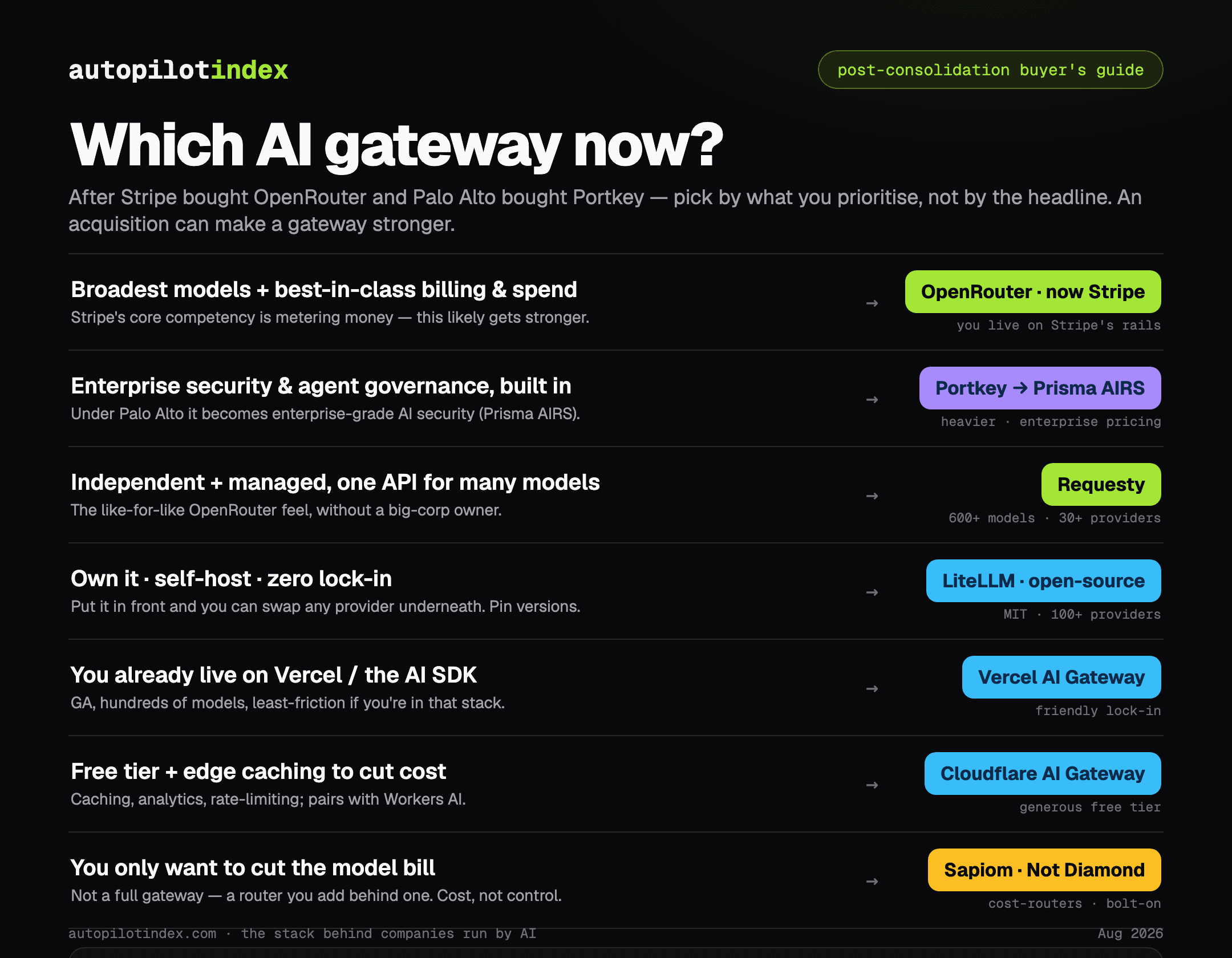
The honest answer isn't "switch away." An acquisition can make a gateway *stronger*: OpenRouter gains Stripe's billing rails; Portkey gains Palo Alto's security. Pick by what you prioritise — broadest models + billing (OpenRouter/Stripe), enterprise security (Prisma AIRS), independent-managed (Requesty), own-it/self-host (LiteLLM, open-source), your existing ecosystem (Vercel, Cloudflare), or pure cost-cutting (add a router like Sapiom or Not Diamond behind whatever you run).
Don't single-thread your gateway. The one you pick today may not exist as an independent company by renewal (see Stripe↔OpenRouter, PANW↔Portkey). Keep it swappable.
Own your fallback. When a provider degrades or a deal closes, the gateway is what keeps you running — make provider failover a hard requirement, not a nice-to-have.
Make cost-routing first-class. Routing routine calls to cheaper models (Sapiom/Sciforium-style) is the single biggest lever on your model bill — the difference between $1.2M and $100K a month. The neutral, portable gateway is the one that lets you pull it.
We're mapping the whole battlefield on the index — every gateway, who owns them now, and the VCs circling. If you run a business on autopilot, which gateway do you trust — and why? Reply and tell me; the honest answers go into the next update.